
Why WeWork Failed
And what we can learn from it about housing

(I watched the Hulu documentary today and felt like I had to comment on it.)
As a former professional real estate guy — I worked in land development — the first thing that grabs your eye about the WeWork documentary is the valuations. At the beginning, Adam Neumann (one of the two co-founders) scores a worn-out Brooklyn warehouse from a Williamsburg landlord, and subdivides and sub-leases it as office space.
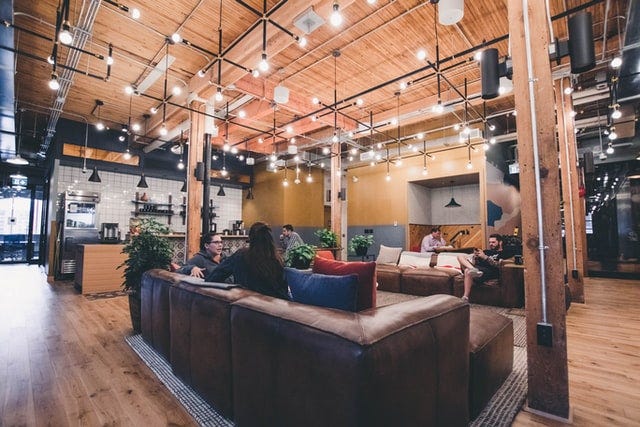
This is the very first WeWork. Any old warehouse — like the one he converted — wouldn’t be worth very much. But in turning it into a co-working space, and thereby paying in turn his landlord a stable rent, he made it valuable. Before this, there was only Regis. Regis was boring, comformist, and intended to be a simulacrum of real corporate offices. It had drab, waiting-room furniture, bland colours, and antiseptic interiors.
WeWork changed all that. It had beer kegs, on-site bars (of both the caffeine and alcohol kind), spacious social and lounging areas, foosball tables and open mic nights. Basically, it was the office transformed into the living room. It had desks you could rent, by the day or week if needed be — and even conference rooms. It was part of the sharing economy.
But it was also very, very New York. I don't think it’s by accident that it started in the Big Apple: not just that Adam arrived, like so many others did, with big dreams. Not even that his assistant, Megan Mallow, and other first employees and enrolees of WeWork, seem to have been similarly bright-eyed and bushy-tailed, without much in the way of real estate experience. It’s more that the problem WeWork was invented to solve is fundamentally a New York one.
Early on in the documentary, Justin Zhen, an early WeWork enrolee (he eventually discovers, through his data-scraping startup, that WeWork was lying about turnover and usage statistics) notes that the New York kitchen — where you could drink beer, hang out, and celebrate friends’ birthdays — was the equivalent of Silicon Valley garages. It was where ideas got thrown around and businesses started.
You realize something which had been obvious all along: Adam Neumann (and Miguel McKelvey) invented a kitchen. Specifically, a corporate kitchen where users could hang out, drink beer, socialize, and share their stories — as well as work. Because they had little private social space at home, WeWork served as their living room and kitchen all rolled into one. That’s why there are beer kegs, snack bars, and coffee machines. That’s also why there’s limited privacy. WeWork was trying to emulate something that existed already — the communal New York kitchen — and copied both its faults and virtues.
The fact that this vision of the kitchen-as-office undergirds everything about WeWork — including, as Doug DeMuro would say, all its “quirks and features” — also explains why it failed. Not just financially, but (now with the hindsight of the Covid pandemic, and endless working from home) why also the model itself. The startups’ appropriation of the New York kitchen was borne out of necessity — people just didn't have enough space — not desirability or necessarily general applicability.
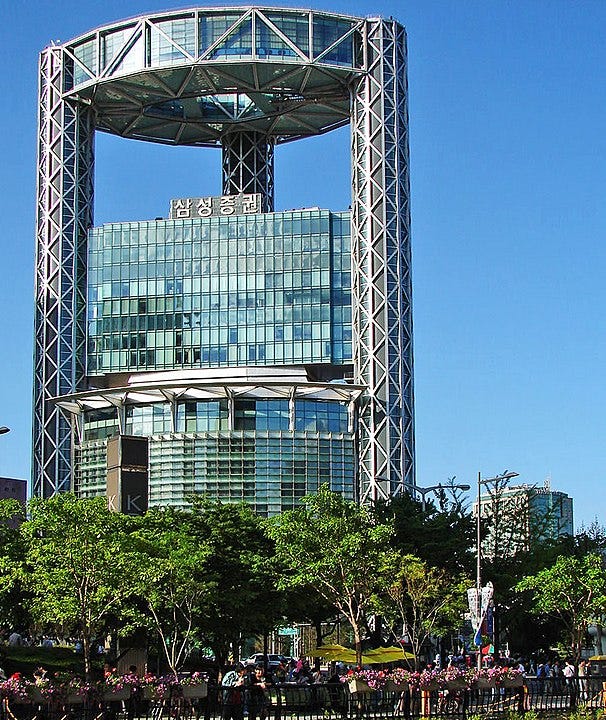
Even in their most grandiose global expansion phase, the most successful locations — such as London, Tokyo, Seoul — were the ones with the most similar physical and social geography as New York. That is, they were located in global cities where many lived in relatively limited quarters and needed, and therefore appreciated, the social spaces provided through WeWork.
This fact explains both what was really exhilarating about WeWork — the liberalization of the office from an uptight, monochrome place to one of work and play — and what was creepy about it as well: the total lack of privacy, not just in a physical sense, but in the lack of separation between life and work.
WeWork tried to make it into a virtue. In failing, it didn't just fail financially — although it did so amply — it also failed as an evangelist for a model that, for a while, looked like the New York’s answer to Silicon Valley coding houses (like the one in the show, Silicon Valley). It’s a failure that reverberates far beyond the financial calumny in which the company was entangled: the dream of a truly communal office, one that celebrates life as much as work, remains as far off as ever.